
• National Shrine of the Immaculate Conception

    Now the salvation and the power and the kingdom of our God and the authority of his Christ have come. —Revelation 12:10

    I didn’t expect to visit the National Shrine this past weekend. But we were lunching with a friend, who mentioned he’d visited the basilica, and there were hours to kill before our evening concert. So why not drive the extra twenty minutes to the largest Catholic Church in America?
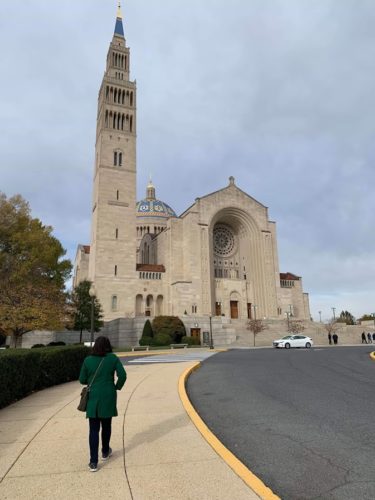
    I’ve spent much time at St. Patrick’s in New York, and visited three of the four major basilicas in Rome. I’ve seen more sacred art and stained glass than I can remember. So the National Shrine is almost deceptive, at first. It’s big, but it’s not flashy. It’s not overly ornate. But as we walked around, I noticed all the details—statues of saints and small side chapels. Mosaics that look like painted artwork. We sat for a while beneath a ceiling mosaic of Creation, of Adam and Eve surrounded by the oceans and the animals, protected by the hand of God.

    I was told the basilica is “impressive.” I’ve seen impressive, but this one isn’t about the seeing. It’s a feeling, like God Himself is walking around with you. There’s no “wow” factor, until you really start to notice the details. And then it’s positively striking.

    The most central mosaic sits behind the altar, and the one I kept circling back to—not just during my visit, but in reflection in the days since. I couldn’t figure it out, at first. It had to be Jesus, but didn’t look like the Jesus we’ve come to recognize. I thought it to be his Risen form, since his appearance changed after the Resurrection. That was an impressive enough interpretation, but the truth was even better.

    Dominating the North Apse is Christ in Majesty, the Apocalyptic Christ. Perhaps the largest mosaic of Jesus in the world, the span from wounded hand to wounded hand measures 34 feet.
    (National Shrine Interactive Map)
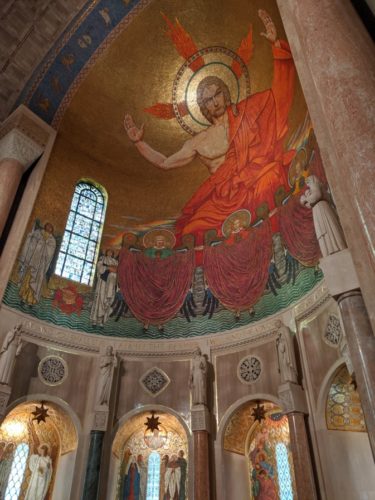
    It’s almost uncomfortable to look at. It’s not Jesus as we know him, and he’s kind of mean-looking and judgmental. But that’s just what it is: the literal, ultimate judgment. There’s a whole great list of the mosaic’s details compared to scripture, which brings even more awe-inspired wonder to this 34-foot artwork.

    We did some more wandering, including down into the crypt and the obligatory gift shop. But even as we left for the concert, “Christ in Majesty” lingered. Jesus is so often depicted as gentle and loving, which isn’t wrong. But the “Judgmental God” part gets overlooked. Maybe we conveniently forget, because death and judgement aren’t things we want to think about. But there it is—the largest mosaic of Jesus in the world.

    I wish we’d had time to see more. The couple hours weren’t enough, and I don’t know the next time I’ll be in D.C. The National Shrine needs all day. I didn’t want to sit and pray, because I wanted to see all I could. But even walking around the nave is a type of prayer. Studying the artwork, and explaining what’s going on in each. Staring up at Creation, or at the majestic figure of the Risen Christ. It is… impressive.

  • Doodling

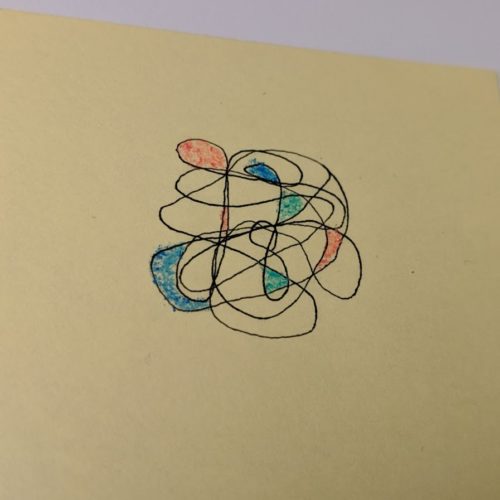
    I was a doodler when I was a kid. Not that I was an artist, but enjoyed drawing lines. I still do—Post-Its on my desk have random scribbles, and meeting agendas have stars and sunbursts around the border. But my favorite high school–era doodle was just a mess of scribbles. I’d draw squiggly lines over and over each other, leaving spaces in between to color in later. It didn’t mean anything. I just liked making nonsense lines.

    As I was trying to think up ways to describe the direction of life in general, I thought of those squiggly doodles. Life isn’t a straight or neatly organized line, but often feels like a dense blob of indecipherable, overlapping chaos.

    I started a new job, again. I’ve admitted to industry friends that it’s almost embarrassing, having announced a new job every two years. I felt guilty for leaving the last one because, when I first accepted the position, it felt right. It was everything I thought I’d been looking for. When I started to consider leaving, I thought it a personal failure. I wasn’t only letting myself down, but worse: I was letting down God. I was giving up on the direction He’d lead me toward.

    But that’s why life squiggles. I was trying to come to terms with my mistake, but… there was no mistake. I’ve always told myself there are no mistakes, but I wasn’t living by my own principle. The job wasn’t a mistake. Moving away wasn’t a mistake. It was a learning experience, a necessary step in my life, and the direction I was meant to go. Even if it wasn’t permanent.

    God will push you in a direction, but it’s rarely a straight line. It takes sharp turns and bumpy back roads. Sometimes you may end up in the same place as before, but with a clearer path. Or a better car. Or just smarter. I don’t pretend to understand how it works, but I know He’s in charge.

    So I’ve taken a turn, again. I’m back working in Manhattan (which I was more than happy to leave before), and packing up for a new apartment. I won’t say “I know what I’m doing this time,” because I never really do. But I’m more at peace, and in better spirits overall. It’s a strange feeling, because it almost seems too easy. Except it’s not, because I’m in the middle of packing and learning how to do a new job and relearning the secrets to commuting.

    It’s like now, instead of drawing all those wayward scribbles, I’m coloring in the spaces. I’m starting to piece together a story, rather than re-writing the outline. Now that I think about it, I suspected something like this would happen: During RCIA, I knew things would just make sense when I was in the right place, spiritually. That once I was part of the Church, everything else would fall into place.

    I thought the “falling into place” was the “new” job, two years ago. I thought it was getting out of Manhattan. I thought I needed major, life-altering changes, because being Catholic was also a major, life-altering change.

    But being Catholic isn’t about changing who I am. It’s the outline, but not the entire story. It is, in a sense, the scribbles. After a while, you have to stop doodling and get to work. You have to fill in the spaces, complete the picture, write the story. I’m still me. I may have ended up in the same geographic location as before, doing the same sort of job, and living in the same relative area. But nothing is really the same.


And they said to him, “Inquire of God, we pray thee, that we may know whether the journey on which we are setting out will succeed.”

And the priest said to them, “Go in peace. The journey on which you go is under the eye of the LORD.”

—Judges 18:5–6

Categories