
• Interior Castle

    Imagine the soul as a diamond, one which God resides in its center: The center burns brightest, and the surrounding facets are each one step closer to that Light. It’s not linear, but concurrent, as each facet competes with and supports one another.
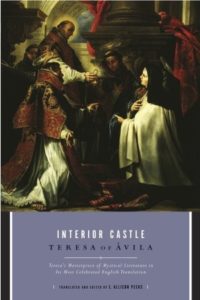

    That’s the concept behind Interior Castle, where St. Teresa of Avila describes the heart of the human soul. As you read (or, travel) through the Mansions, each one gets progressively more supernatural and mystical. Gradually, human effort ceases and God Himself takes over. As a result, I often had to read paragraphs (or entire chapters) several times. Not only because she goes spectacularly off-topic (it’s quite charming, really), but because at its heart is understanding and union with God—which is no small matter.

    the first three Mansions are perhaps easiest to understand, as they’re dependent mostly on human labor. We search for God; we strive for good; we set aside time for prayer. But God starts to take over in the fourth Mansion, which was a chapter I read over at least twice. That’s where things start to get more supernatural, when God begins talking to us.

    If His Majesty revealed His love to us by doing and suffering such amazing things, how can you expect to please Him by words alone?

    It’s natural to go into this sort of work wondering where you reside, where you are in your own spiritual journey. It’s easy to dismiss the earliest Mansions, especially the part where you sit outside the castle. (You are, after all, seeking something by reading this book at all.) But there’s no clear-cut answer. You recognize yourself in each of the Mansions (at least, the early ones), to some degree. There are moments we’re groping in the dark in search for God, and moments where He completely takes over. It wasn’t until halfway through the book that I understood this non-linear, diamond-like description of the soul. It isn’t merely one step at a time, but multiple steps simultaneously. Even in the final Mansion, which is complete union with God, there’s no saying one can’t stray and find herself searching once again.

    St. Teresa is often rambling about how much she doesn’t know, or how she’s too stupid to explain any of this. On the contrary! This naked humanity helps to shed light on the topic—because if someone so “stupid” as she can write it, someone like me could begin to understand it.

    Anyone who fails to go forward begins to go back, and love, I believe, can never be content to stay for long where it is.

  • Seder Passover Dinner

    When I was on my European tour, there was another tour group we consistently bumped into. They were bilingual, so their signage read “Groupo Pablo’s Group.” We loved Pablo (and his group), and the witticism of his bilingual signage. I think of that now for Passover, when I ask my Jewish boyfriend, “Isn’t Passover Seder redundant?” In theory, yes—the Seder is only for Passover, and only a dinner—but I couldn’t help but borrow from Pablo when talking of the multiple Seder Passover dinners I partook in this year.

    My knowledge of the Seder was limited, but with Passover landing on Good Friday this year, it seemed the right time to learn. (The boyfriend, and thus extended Jewish family, also helps.) The meal is a foreign entity to a Gentile at first, and his siblings may have been less than amused by my incessant questions. I had a lot. What’s with the extra glass of wine? And that roasted egg? Or, the question we all bonded over, is it time to eat yet?

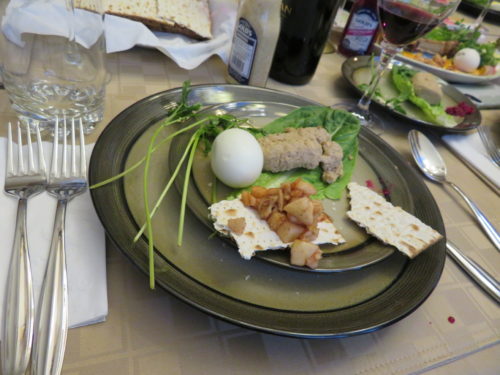
    But when reading through the ritual, the basic concept isn’t foreign at all. The shankbone, representing the sacrificial lamb. The bitter herbs, consumed by the Israelites with the meat. The charoset, representing the brick-making mortar when enslaved. Passover is an eight-day celebration of God’s victory over the Egyptians, a liberation from slavery!


    (Mortar is delicious)

    I’ve always desired to understand Jewish tradition, wondering especially why Christians don’t recognize them. This is our history, too, and Jesus’s life didn’t negate the miracles God wrought before his coming. In fact, Jesus himself was a practicing Jew—he worshiped in the Temple and celebrated the holidays, especially Passover. The Seder itself was his last meal, and honoring this tradition helps to better understand his sacrifice. Because as a Christian, there’s even more in this honored meal. And that we learned in our second Passover celebration—we also visited my old Baptist church, who hosted a Messianic Seder.

    We ended up at a table with another Christian/Jewish couple, which I joked were the only two Jews in the room (probably true). They sang along to the prayers in Hebrew, and the rest of us followed in English. A Messianic Seder throws you off at first, because there are some new prayers in the mix. In addition to liberation and freedom, there are Hebrew prayers about Jesus. They talk of the Last Supper. The “Paschal Lamb” takes on a new meaning, in addition to being the last meal before the Hebrews fled.

    A couple of my favorite Passover Jesus moments in the Seder:

    • The four cups of wine, drank throughout the meal: Each cup is symbolic, representing different promises from God. During the Last Supper, Jesus offers a cup (“in remembrance of me”) after they’ve eaten, making it the third cup of wine—the Cup of Redemption.
    • The hiding of the Matzah: Before they eat, the father breaks off a piece of bread, wraps it in a linen napkin, and hides (“buries”) it. Afterward, it is again unveiled (or, “risen”) and the father breaks off a piece for everyone at the table—the breaking (i.e., death), burial, and resurrection. Bonus – distribution to all!

    When I shared my Seder experiences on social media, a friend replied, “Passover adds such a richness to the Easter experience!” It is, after all, the very same meal that we recognize on Holy Thursday. If it were up to me (clearly, I have control over these things), the Seder would follow that Thursday Mass—in the very same way it did for Jesus and his disciples.

    I almost forgot my actual favorite part of the Messianic Seder—beating up on Da Vinci’s Last Supper. Besides the obvious fact they occupy the same side of the table, and are sitting rather than reclining, the table also features… dinner rolls. How ’bout that leven?


And they said to him, “Inquire of God, we pray thee, that we may know whether the journey on which we are setting out will succeed.”

And the priest said to them, “Go in peace. The journey on which you go is under the eye of the LORD.”

—Judges 18:5–6

Categories