
• Outpouring of Divine Love

    Adjusting to my Lenten schedule took a grudgingly long time. Lately, I’ve been even busier than usual—at work, after work, on weekends… sometimes, I forget to take a break. I get into bed without reading that six-minute daily study, and throw off the covers to find the little black book. Or I return home after another late rehearsal, forcing myself to stay awake to read a few pages of St. Teresa.

    It would be easier not to bother: I’d get more sleep. There would be more time to practice music. I might actually finish a video game.

    But yesterday, I stepped away to take that quiet hour in an empty church. It was a pain to find parking. I circled the block a couple times before a space emerged, tempted all the while to just go back to the office. But when I finally settled in a pew, and took the time to breathe… I remembered. I had a print-out of this week’s lectio divina. I read the Bible verses over and over again. Suddenly, Jesus wasn’t only speaking to the surrounding people in some distant past. He was speaking to me. He was chastising me for my sinfulness. But, as I sat beneath a larger-than-life-size crucifix, he loved me.
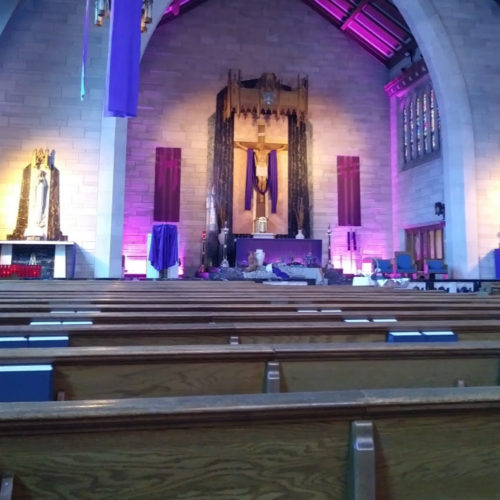
    Sometimes, God is an abstract entity. It’s like reading a history book—logically, you know it’s real and it happened, but also can’t fathom events that occurred before your physical existence. God is similar. He’s there, and we try to connect, but His lack of physical presence makes it difficult. But the difference is, God isn’t past. He’s here, always, and there are snippets of time that we can latch onto Him. That’s why, even though I was sitting in a church in Princeton, New Jersey, I was standing on a mountain with Jesus in Galilee. I felt the warm breeze under a desert sun. And I could feel His presence as I stood close by, listening intently to His sermon.

    I wonder sometimes why I don’t feel Him all the time. There are signs of Him everywhere, in the prayer card in my wallet or the cross I fiddle with around my neck. But when experiencing even a glimpse of His presence, I understand why I shouldn’t—it’s overwhelming. It’s an outpouring of emotion, an inability to focus on anything else. If God allowed that in all moments, we couldn’t handle it. Besides, those bursts of divine love wouldn’t be as special. God would become commonplace, which is the last thing He could ever be.

    “Mental prayer in my opinion is nothing else than an intimate sharing between friends; it means taking time frequently to be alone with Him who we know loves us.”
    —St. Teresa of Avila

    No relationship is easy, and the relationship with the Divine Creator is the most difficult of them all. We’re flawed human beings, and have a hard time grasping at the intangible. But when we sit down and truly talk with Him, and listen, He becomes anything but intangible.

    Then, I remember why I bother.


  • In This Moment

    I’m not particularly good at yoga. I keep on going because, maybe, one day I’ll reach my toes or balance on one foot without toppling over. But this week, it was different. I still lost my balance—several times—but the instructor continuously reminded us to be conscious of ourselves, right now. Her repeated mantra stuck in my head.

    Live for now. Be in this moment.

    It wasn’t so easy. We dwell on past events, or plan what to do next. We don’t think about right now, and end up missing it because we’re thinking about the next event (that we’ll be too preoccupied to experience, too).

    During resting pose, the instructor permitted a moment to dwell on the past. We’re not to ignore it, but accept it as past. It’s done. As I lay with my eyes closed, and with her gentle prodding, I was abruptly overcome with memories and emotions. It was like I lived in that past again, with those same people, with those same constant conflicting emotions. It was a sense of joy, but with an underlying sadness that I could only recognize now, not then.

    Acknowledge it, and let it go. Be in this moment.

    It didn’t go away instantly. But when I rose, I felt lighter. There was clarity. In that moment, I lived in the moment. Even something as simple as rolling up my yoga mat felt invigorating, like I had never experienced it before—the bumpy plastic of the mat, and the gritty feel of dirt on my hands from the floor. The room was a little chilly, and it was refreshing rather than annoying.

    So much of life is this dwelling and planning. I analyze wrongs in past relationships to avoid the same mistakes, while inadvertently avoiding other issues; I wonder why I can’t achieve the happiness and success I once had. I constantly check the calendar to make sure I’ll be at the right place, at the right time; I plan the next book to read before finishing the current one.

    Seldom do I live right now.

    Let’s change that.

    Recently, I’ve spent some time in an empty church during lunch break. I sit in the pews, lit only by blue-tinged sunlight through stained-glass windows. I’m only vaguely aware of the time, mostly because I’ll have to return to work at some point. But in that twenty or so minutes, I’ve released everything. The recent past of driving there no longer matters, because it’s done. I have arrived, so the future plans have become present. I simply live.

    I won’t say I don’t get distracted, or think about what I’m doing next, but that brief silence clears the weight of mental bustle. It releases me from the past. Once that is cleared away, it allows God to reemerge. He’s there, buried under the debris of my own worries. He’s capable of breaking through on His own, but waits for me to pick through the rubble myself.

    These silent moments help to live the now in the coming days. He’s there in the gentle buzz of the morning alarm. He’s there when I read, feeling the smooth pages under my fingers. He’s there inside the car warmed by sunlight, even if it’s still cool outside. By living now, he allows Him time to breathe. When I spend less time dwelling and planning, it permits Him room to do what He has to do.


And they said to him, “Inquire of God, we pray thee, that we may know whether the journey on which we are setting out will succeed.”

And the priest said to them, “Go in peace. The journey on which you go is under the eye of the LORD.”

—Judges 18:5–6

Categories