
• Church On-the-Go

    I spent a lot of time in airports this past weekend. Back-and-forth for work, squeezing in a food-court dinner during a layover, checking the “departures” screen again because I forgot my gate, again. During the layover rush on my journey outbound, I spied a small “chapel” sign pointing up a long staircase. My gate ended up being not too far from this staircase, and there was still a half-hour before my plane boarded, so I gathered my bags and toted them upstairs.
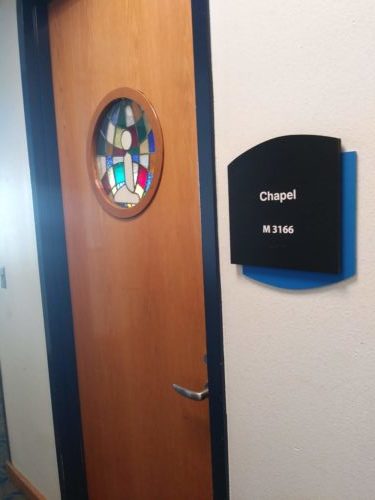
    Despite being located in the bustle of an airport, you hardly hear the commotion once the door closes behind you. I was greeted by a chapel worker on my way in, but she was packing up for the day, and I was soon alone in the small room. There was a bookshelf by the door holding various religious texts, atop which sat their prayer cards and a basket of plastic rosary beads. I took a rosary, despite having one in my purse—there was a novelty to the plastic airport beads—and a Divine Mercy prayer card.

    I was alone in the chapel, with the office worker gone, which gave me a chance to look around. Besides the bookshelf at the entrance, a table sat up front holding a plastic plant and several religious texts. One of them was open, which I assumed was the Bible; it was Sunday, so they likely had a small, intimate Mass hours before I arrived.
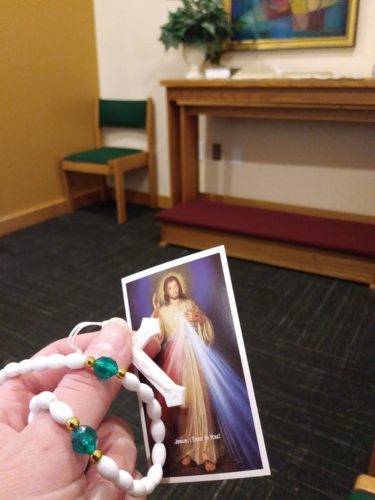
    I’d intended to pray the Divine Mercy chaplet, or simply close my eyes in quiet contemplation. But, being me, I simply had to see what other books sat on that table.

    The open Bible was between a Qur’an and an English/Hebrew Torah. I flipped through the Torah, first from the wrong way, because that’s how it lay on the table. But, being left-handed, the “backward” way felt more natural when I started at beginning. I skimmed the first few lines of Genesis, comforted by the familiarity of our creation. “God saw that it was good.” And it was.

    I made a mental note to invest in a Torah. I can’t read Hebrew for anything, but it feels like home, somehow. Even reading those first few verses, knowing we have the same God and the same foundation. It wasn’t the prayer time I’d expected going into the chapel, but those few minutes were much welcome in the hurry of travel. Speaking of which… I had a plane to catch.

    I tried to find the chapel in the layover airport on the way home, too. There were signs for it, which I followed across terminals, but soon discovered that the chapel lay beyond the security point. I’d have to leave, and then go through security again, which no one wants to do more often than they need to. But I liked knowing that it was there. It became my duty to find the chapel in any future airports I visit, to express gratitude for those who worked it and for the God who kept me safe in my journeys. The airport chapel is an unassuming room tucked away somewhere, a place of quiet in an unexpected location. And it’s my new favorite place to visit, a necessary waypoint as I’m busy traveling somewhere else.


  • Matthew 12:12

    And Jesus entered the temple of God and drove out all who sold and bought in the temple, and he overturned the tables of the money-changers and the seats of those who sold pigeons.

    Scene: Jesus approaches the Temple with his disciples, its structure massive and looming before them. This is the center of Jewish worship, holding the very presence of God. But nearby, there are vendors hawking their wares. Tables of overpriced pigeons to be used for sacrifices, and likely others peddling miscellaneous, useless goods.

    And Jesus is mad. “My house shall be called a house of prayer,” he says, “but you make it a den of robbers.” (Matt 21:13) He flips their tables, which I imagine an amusing sight. Gold trinkets clattering to the stone floor, and pigeon feathers scattering everywhere as the birds escape.

    It’s easy to see this and feel justified in our own angers. Jesus was clearly agitated, so it’s okay if we get angry, too, when things don’t go our way. But is our anger justified?

    It’s a tricky emotion. Consider the anger’s source: is it the result of your own elevated self-worth, or situations beyond your control? Or have all these little things piled on that you don’t remember the origin, and you’re just angry at everything and everyone who tries to rationalize with you?

    I’ll admit, sometimes I’m quick to anger. Frustration with friends, co-workers, or highway drivers; a lack of understanding when I’m trying to learn something; a miscommunication that spiraled into an argument. I justify my emotions, because “Jesus flipped tables,” too. As if my irrational moods can be compared to the Son of God. Thinking of that scene at the Temple, I’d be angry, too. Those peddlers are interrupting my prayer time. They’re loud and annoying, and can you please just let me pass? But that’s not Jesus’s anger. He wasn’t angry for his own sake, but because they were defacing the Temple of God. His anger was for the sake of the Father.

    Therein lies the difference. My impatience is usually selfish. I’m misunderstood, or I’m inconvenienced, or a situation makes me look bad. I’m being a whiny child who isn’t getting what she wants. This sort of anger has no roots in the spiritual realm and, without God, is unjustified.

    Because in the end, none of this is about me. In keeping God at the center, I may (surprise!) even feel less angry overall. More compassionate, understanding, and willing to compromise. Jesus was swarmed by people all the time, a crowd that would have likely sent me into a claustrophobic panic attack. But he didn’t drive them away. He didn’t get mad at them for constantly asking to be healed. He loved and cared for them, and I can work to do the same.


And they said to him, “Inquire of God, we pray thee, that we may know whether the journey on which we are setting out will succeed.”

And the priest said to them, “Go in peace. The journey on which you go is under the eye of the LORD.”

—Judges 18:5–6

Categories