
• The Extroverts

    This season’s Bible study is on Mary, and I have a lot of questions. I told my small group first thing that I’m still learning a lot about Catholicism itself, and especially the Blessed Mother. As a result, I talk a lot during class. I think out loud. It’s a group brainstorm, trying to discern details between the lines of scripture.

    During our second class, the group leader turned to the quieter corner of the room. The ones who hadn’t said as much, compared to the rest of us loudmouths. “Everyone is welcome to join in,” she said. “Don’t let these extroverts do all the talking.”

    I hid a laugh behind my study guide. “Don’t tell anyone,” I said, “but I’m secretly an introvert.”

    It’s honestly no secret: I don’t like parties with too many people. I get panicky on busy city streets. I recharge in the comfort of solitude, curled on my oversized chair with a cup of tea. Social interactions are enjoyable, but limited. Even when I do gather with friends I’m often on the sidelines, happy to observe rather than participate.

    But things change when I talk God, whether it’s among other people or just with Him. I’ll excitedly flip through Bible pages, or ramble for hours, and there seems to be no end to my energy.

    The group leader laughed at my confession. “That’s Holy Spirit,” she said.

    Despite my natural introverted state, I couldn’t argue. God knows I don’t have that kind of energy, especially 8:30 at night during class. It’s not just during Bible study, either: I have a lot to say about God, and will talk the ear off anyone who asks about my conversion. This is, perhaps, the most external evidence I have of God’s presence. While it’s natural to be excited, it’s unnatural for someone who so often keeps to herself.

    It wasn’t always that way. I grew up with a lot of non-believing friends, and was too shy to try changing their minds. I even didn’t discuss the day’s sermon after church, preferring to silently contemplate it on my own. I don’t know when this changed. Maybe when I had more Christian friends, or at least friends who respected Christians. Maybe when I met someone who wanted to talk and debate about God, in a respectful (rather than demeaning) way. I do know it had a lot to do with joining the Church, a place where I was able (and encouraged) to both question and worship God at the same time.

    Still, I’m hardly an extrovert. I return from Bible study, decompressing with a cup of tea on my chair. But maybe, when I really need it, God gives me that little extra oomph.

  • San Sebastiano

    When I was planning my trip to Rome, I briefly considered stopping by the home of my ancestors, Villa San Sebastiano. It was only an hour and a half away. I researched the public transportation options, but the plan was soon thwarted. No trains stopped there, and I certainly couldn’t rent a car with my limited Italian. I wasn’t too disappointed, but content enough knowing I’d be that close by.

    I’d nearly forgotten about the almost-impromptu plans as we traveled the country, with so much else to see. We visited catacombs one evening later in the trip, the bus rumbling over cobblestone streets barely wide enough to contain it. When we came to a bumpy stop in front of the basilica, I was greeted with a surprising sign on its stone wall: catacombe s. sebastiano

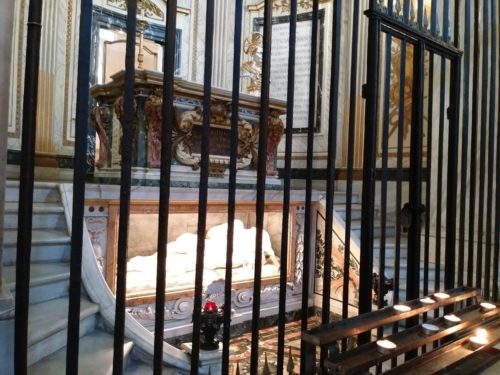
    No, we hadn’t reached the village; instead, we stepped into the basilica that bore his name, the resting place of his tomb.


    (An unfortunate camera phone shot, since I’d left my real camera on the bus)

    Despite everything, I didn’t know a lot about St. Sebastian. I knew he was martyred by being shot by an arrow, that very same arrow on display in the basilica. I knew he had at least two Italian villages named after him. But what was his life? Who was the man whose tomb I knelt before, who made me emotional simply for being my ancestor’s patron?

    After some quick research, I learned we don’t know much about him. There’s a vague idea of where he grew up (Milan, maybe?), and that he enlisted in the Roman Army. It was the 3rd century A.D., an era of Christian persecution, with the emperor infamous for putting them to death. Sebastian never revealed that he was, in fact, a Christian himself, but enlisted to save others from persecution. He rose to a captain of the Praetorian Guard, whose job was to protect the emperor. Despite his hidden faith, he secretly shared the Word and helped many to conversion.

    Of course, he was eventually discovered. His position meant little; in fact, the emperor likely wasn’t pleased to have such a traitor in his ranks. Sebastian was ordered to be tied to a tree for target practice, thus pierced by innumerable arrows.

    But—and this is a fact I didn’t know—the arrows didn’t kill him. Miraculously, he was still alive, and nursed back to health by a fellow Christian. He wouldn’t keep to the shadows now, though: He called out the emperor for his cruelty against Christians (imagine his surprise to find Sebastian still alive), but that bold move sealed his fate again. Sebastian’s “second execution” was his final, being clubbed to death and thrown into the sewer. (His body was later found, and secretly buried in the catacombs that ultimately bore his name.)


    At the tomb, I rummage through my purse for loose change. I dropped a fifty cent piece into the offering box and lit a candle. The real types, with wicks, rather than the now-popular LEDs. I didn’t leave an offering at many churches on that trip—there had been so many of them—but for this one, it seemed right.


And they said to him, “Inquire of God, we pray thee, that we may know whether the journey on which we are setting out will succeed.”

And the priest said to them, “Go in peace. The journey on which you go is under the eye of the LORD.”

—Judges 18:5–6

Categories