We’re often asked why Jesus had to come at all. After all, God can do anything. He could flood the face of the earth. Or He could whisk us all to Heaven at this very moment, basking in Heavenly light. He could appear in a cloud and demand our attention, bringing us to our knees in awe and fear.
Instead he came here personally, as a human being. And let himself be rejected. Why all the effort?
Israel never knew how to clean up its act. They stumbled, over and over again. God threatened to disown them, over and over again. But they begged and pleaded for forgiveness, and God granted it to them. God allowed them to stumble in order to show His infinite goodness. And with that, also prove that they needed him. Jesus didn’t come during a time of prosperity—it was an era of silence from God, in a dry spell of prophets. He arrived when hope was lost. In that darkness, He became Light itself. He arrived after Israel had learned they couldn’t do it alone.
I was reminded of this recently, when watching an interview on the Torah. In a similar fashion, they asked why God took so long to present the Ten Commandments. It’s not something I’d thought of before, since it seems to appear pretty early on. But when you consider the whole of history, and all that had happened before this event… it doesn’t.
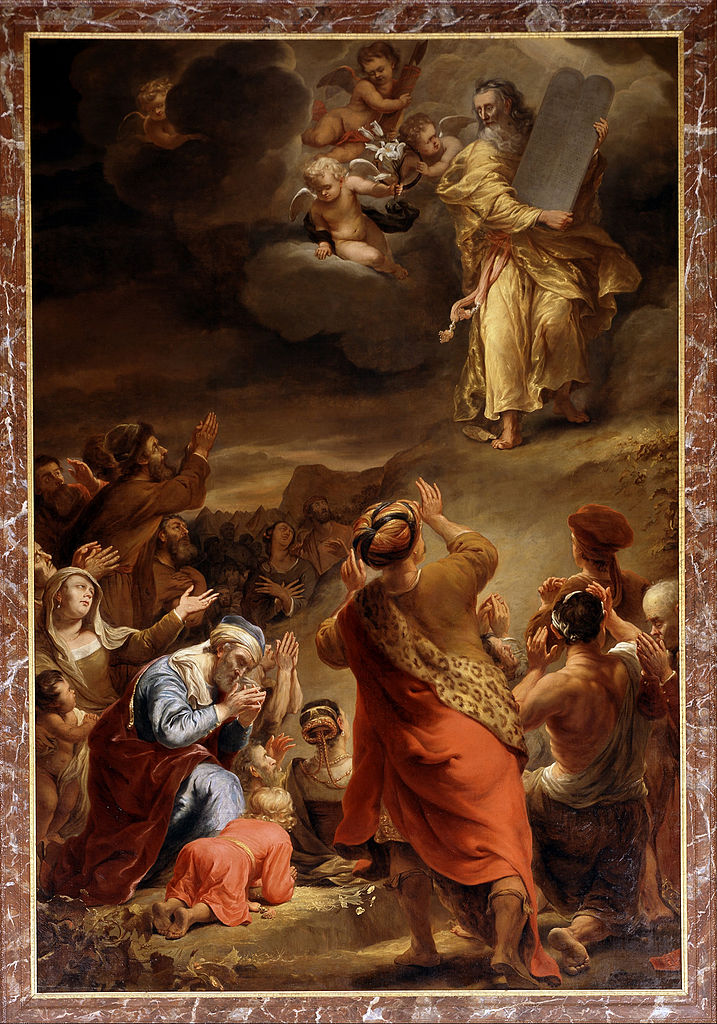
Moses descends from Mount Sinai
with the Ten Commandments
Ferdinand Bol, 1660-1662
(Can you tell I’ve been into sacred art lately?)
There was a whole lot of history before Moses descended from Mount Sinai: Adam and Eve. The Tower of Babel. The flood. It’s even after Egypt itself, after the Israelites had been slaves for 400 years. Certainly they’d needed guidance during that time, and especially when they were vying for their freedom.
Despite my curiosity, the answer was one I should’ve known—the Israelites first had to learn they needed the Commandments. And they had to spend some time in darkness before God could save them.
They were doing pretty poorly on their own. Killing their siblings? Building a tower to reach Heaven? They were lost and searching for answers, trying (and failing) to seek this mysterious God. But God’s people had to fail. They needed guidance, but they first needed to discover this need on their own. It was only when they were whining and wandering the desert did God intervene with Hope.
He did it on Mount Sinai, and He did it again in Bethlehem.