
• Waking Up Catholic

    I had tried extremely hard not to put labels on my faith; however, society’s norms crept in. I labeled myself a non-denominational Christian, but it didn’t bother me. As long as I was practicing my faith in ways that I enjoyed I decided that labels didn’t matter.
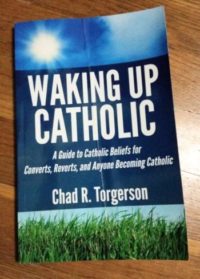

    The subtitle claims this to be for converts, but I’ll argue it’s for everyone. It’s for Catholics who don’t know how to explain their faith. It’s for non-Catholics who don’t know what those people believe. It’s for Catholic friends of converts who want to understand the church from where their companions once hailed.

    This little book is deceiving. It’s not flowery or preachy; it’s peppered with grammatical errors and sometimes he shares the same story more than once. But from chapter one, we’re discussing the Trinity. Chapter two is all about going “non-denominational” and avoiding labels. (Hence the quote up top. I could’ve written that myself.) It’s simple, but it’s also clever. Because each chapter builds upon the last, and by the end we have this new, complete knowledge of Catholicism. And then we’re instructed to tell others about it. Go be evangelicals. Tell everyone how great God is.

    I only wish I’d had this book months ago, because it’s a really good beginning to the conversion journey.


  • Finding What’s Missing

    The first time I attended a Catholic lecture, I was wholly and truly lost. This guy was a Ph.D. who knew a whole lot about St. Augustine, and my little non-Catholic brain couldn’t grasp any of it. This entire religion is over my head, I thought, even as I picked out bits that I did understand.

    But there was one thing he said during the Q&A that I never forgot. The question had something to do with other religions, but the question itself right now is irrelevant. In his answer, he explored the “missing pieces” of non-Catholic faiths. His comment, of which I am grossly paraphrasing, was, “All the other denominations broke off from the Catholic Church. They took bits and pieces of what they liked, and created their own religions. It’s no wonder why so many of them feel like something is ‘missing’ in their faith. They don’t have the full picture. The fullness of the Catholic faith is required for full communion with God.”

    Afterward, as I walked with my friend back to the bus depot, I wouldn’t shut up about it. “I’ve said that!” I declared, trying to have a deep conversion as we dodged Times Square tourists. “I’ve told you something is missing!”

    I’d suspected this for years. I’d sit in church services and feel a disconnect, like God is just out of my reach. I’d go about my life aimless, unsure if He even heard my prayers, convinced there was something more I should be doing. That night, it finally clicked: something was missing. And that “something” was the fullness of the Church. I hadn’t the first clue of Tradition in those days—and I certainly didn’t know a word of Mass—but I was comforted when surrounded by it, for reasons I didn’t fully understand.

    Being raised non-denominational will only get you so far. There comes a point that you desire more—more for your life, more connection to God, more in your worship. But the answer was always there. We all have bits and pieces of what our non-Catholic church founders thought was relevant, and they threw away the rest. But that leaves you with an emptiness that no offshoot religion will fill. At least, that was the case for me.

    This was before I’d started RCIA. It was before I’d even decided to convert. I may not have understood most of the lecture, but God brought me there anyway to hear that one answer. And hearing that one answer already started filling in that emptiness.


And they said to him, “Inquire of God, we pray thee, that we may know whether the journey on which we are setting out will succeed.”

And the priest said to them, “Go in peace. The journey on which you go is under the eye of the LORD.”

—Judges 18:5–6

Categories